Meaningful weight and hunger reductions in children and adults

In patients 6 years and older with obesity due to POMC, PCSK1, or LEPR deficiency

IMCIVREE delivered significant and clinically meaningful weight loss1

  • POMC or PCSK1 deficiency: 80% of patients achieved a ≥10% weight loss from baseline after 1 year (95% CI: 44.4%, 97.5%; P<0.0001; N=10)1,2
  • LEPR deficiency: 45.5% of patients achieved a ≥10% weight loss from baseline after 1 year (95% CI: 16.8%, 76.6%; P=0.0002; N=11)1,2

IMCIVREE was studied in 2 identically designed, 1-year, open-label studies, each with an 8-week, double-blind withdrawal period in patients 6 years and older with obesity due to POMC, PCSK1, or LEPR deficiency.1,2

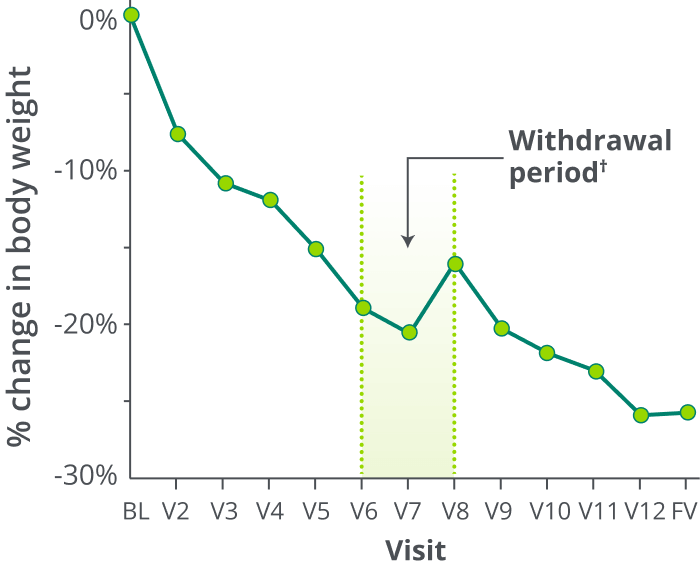
POMC/PCSK1 Deficiency: Mean Percent Change in Body Weight Over 1 Year (n=9)*,1

POMC deficiency treatment results showing 23.1% mean weight reduction after 1 year, with weight regain during withdrawal and reduction after treatment restart
In patients 6 years and older with POMC deficiency, there was a 23.1% mean reduction in weight from baseline after 1 year. Weight increased during the withdrawal period and then decreased once treatment was reinstated.

23.1% mean reduction

in weight from baseline

after 1 year (95% CI: -31.9%, -14.4%;
P=0.0003; N=10)

Weight increased during the withdrawal period, then decreased once treatment was reinitiated

*Participants who achieved weight loss threshold (≥5 kg or 5% if baseline body weight was <100 kg) during the 10-week open-label period.1

The withdrawal period lasted 8 weeks, which included 4 weeks of IMCIVREE followed by 4 weeks of placebo.1

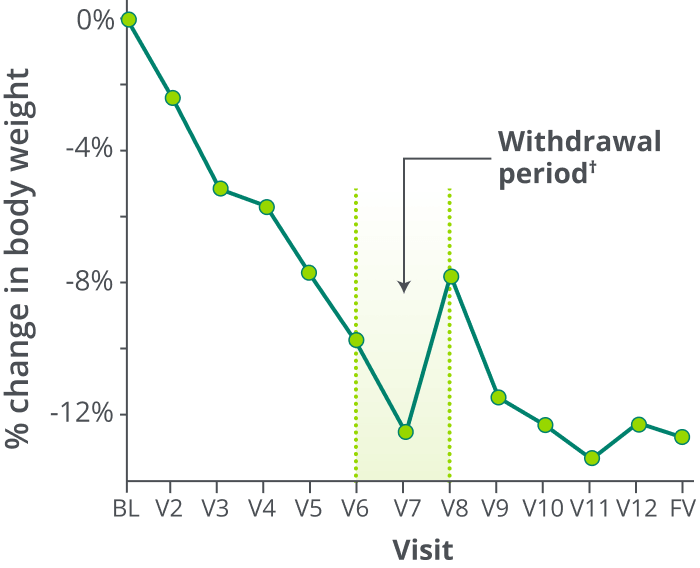
LEPR Deficiency: Mean Percent Change in Body Weight Over 1 Year (n=7)*,1

LEPR deficiency treatment outcomes showing percent weight change over 1 year with withdrawal and re-treatment phases
In patients 6 years and older with LEPR deficiency, there was a 9.7% mean reduction in weight from baseline after 1 year. Weight increased during the withdrawal period and then decreased once treatment was reinstated.

9.7% mean reduction

in weight from baseline

after 1 year (95% CI: -16%, -3.3%;
P=0.0074; N=11)

Weight increased during the withdrawal period, then decreased once treatment was reinitiated

*Participants who achieved weight loss threshold (≥5 kg or 5% if baseline body weight was <100 kg) during the 10-week open-label period.1

The withdrawal period lasted 8 weeks, which included 4 weeks of IMCIVREE followed by 4 weeks of placebo.1

In patients 12 years and older with obesity due to POMC, PCSK1, or LEPR deficiency

IMCIVREE decreased hunger over 1 year1

2-point reduction

in median hunger score for POMC or PCSK1 deficiency

In patients with obesity due to POMC or PCSK1 deficiency (n=8), IMCIVREE demonstrated a median 2-point reduction in maximal hunger score at 1 year (Range: -6.5, -0.1)

3.4-point reduction

in median hunger score for LEPR deficiency

In patients with obesity due to LEPR deficiency (n=8), IMCIVREE demonstrated a median 3.4-point reduction in maximal hunger score at 1 year (Range: -4.7, 1.0)

When treatment was withdrawn, hunger scores generally worsened and then improved when IMCIVREE was reinitiated.1

I’m very satisfied. I've lost a lot of weight, and I have a lot more energy. It's nice to see that someone is paying attention to this, and there’s a medication.

– Person who is living with POMC deficiency

A lot has changed. Today, my hunger is, I assume, on the same level as other people.

– Person who is living with POMC deficiency

Individual results may vary.

Get your patient started with IMCIVREE.

See efficacy data for IMCIVREE in young children.

CI=confidence interval, LEPR=leptin receptor, MC4R=melanocortin-4 receptor, PCSK1=proprotein convertase subtilisin/kexin type 1, POMC=proopiomelanocortin.

Indication

IMCIVREE is indicated to reduce excess body weight and maintain weight reduction long term in adults and pediatric patients aged 2 years and older with syndromic or monogenic obesity due to pro-opiomelanocortin (POMC), proprotein convertase subtilisin/kexin type 1 (PCSK1), or leptin receptor (LEPR) deficiency confirmed by genetic testing demonstrating variants in POMC, PCSK1, or LEPR genes that are interpreted as pathogenic, likely pathogenic, or of uncertain significance (VUS).

Limitations of Use

IMCIVREE is not indicated for the treatment of patients with the following conditions as IMCIVREE would not be expected to be effective:

  • Obesity due to suspected POMC, PCSK1, or LEPR deficiency with POMC, PCSK1, or LEPR variants classified as benign or likely benign
  • Other types of obesity not related to POMC, PCSK1, or LEPR deficiency, or other FDA-approved indications for IMCIVREE, including obesity associated with other genetic syndromes and general (polygenic) obesity

Important Safety Information

Contraindications

Prior serious hypersensitivity to setmelanotide or any of the excipients in IMCIVREE. Serious hypersensitivity reactions (e.g., anaphylaxis) have been reported.

Warnings and Precautions

Disturbance in Sexual Arousal: Spontaneous penile erections and increased frequency of penile erections in males have occurred. Inform patients that these events may occur and instruct patients who have an erection lasting longer than 4 hours to seek emergency medical attention.

Depression and Suicidal Ideation: Depression and suicidal ideation have occurred. Monitor patients for new onset or worsening depression or suicidal thoughts or behaviors. Consider discontinuing IMCIVREE if patients experience suicidal thoughts or behaviors, or clinically significant or persistent depression symptoms occur.

Hypersensitivity Reactions: Serious hypersensitivity reactions (e.g., anaphylaxis) have been reported. If suspected, advise patients to promptly seek medical attention and discontinue IMCIVREE.

Skin Hyperpigmentation, Darkening of Pre-existing Nevi, and Development of New Melanocytic Nevi: Generalized or focal increases in skin pigmentation occurred in the majority of IMCIVREE-treated patients. IMCIVREE may also cause development of new melanocytic nevi or darkening of pre-existing nevi. Perform a full body skin examination prior to initiation and periodically during treatment to monitor pre-existing and new pigmented lesions.

Adverse Reactions

  • Most common adverse reactions (incidence ≥20%) included injection site reactions, skin hyperpigmentation, nausea, headache, diarrhea, abdominal pain, back pain, fatigue, vomiting, depression, upper respiratory tract infection, and spontaneous penile erection

Use in Specific Populations

Treatment with IMCIVREE is not recommended when breastfeeding. Discontinue IMCIVREE when pregnancy is recognized unless the benefits of therapy outweigh the potential risks to the fetus.

Please see full Prescribing Information for additional Important Safety Information.

References: 1. IMCIVREE [prescribing information]. Boston, MA. Rhythm Pharmaceuticals, Inc., 2026. 2. Clément K, van den Akker E, Argente J, et al. Efficacy and safety of setmelanotide, an MC4R agonist, in individuals with severe obesity due to LEPR or POMC deficiency: single-arm, open-label, multicentre, phase 3 trials. Lancet Diabetes Endocrinol. 2020;8(12):960-970. doi:10.1016/S2213-8587(20)30364-8

Indication and Important Safety Information

Indication

IMCIVREE is indicated to reduce excess body weight and maintain weight reduction long term in adults and pediatric patients aged 2 years and older with syndromic or monogenic obesity due to pro-opiomelanocortin (POMC), proprotein convertase subtilisin/kexin type 1 (PCSK1), or leptin receptor (LEPR) deficiency confirmed by genetic testing demonstrating variants in POMC, PCSK1, or LEPR genes that are interpreted as pathogenic, likely pathogenic, or of uncertain significance (VUS).

Limitations of Use

IMCIVREE is not indicated for the treatment of patients with the following conditions as IMCIVREE would not be expected to be effective:

  • Obesity due to suspected POMC, PCSK1, or LEPR deficiency with POMC, PCSK1, or LEPR variants classified as benign or likely benign
  • Other types of obesity not related to POMC, PCSK1, or LEPR deficiency, or other FDA-approved indications for IMCIVREE, including obesity associated with other genetic syndromes and general (polygenic) obesity

Important Safety Information

Contraindications

Prior serious hypersensitivity to setmelanotide or any of the excipients in IMCIVREE. Serious hypersensitivity reactions (e.g., anaphylaxis) have been reported.

Warnings and Precautions

Disturbance in Sexual Arousal: Spontaneous penile erections and increased frequency of penile erections in males have occurred. Inform patients that these events may occur and instruct patients who have an erection lasting longer than 4 hours to seek emergency medical attention.

Depression and Suicidal Ideation: Depression and suicidal ideation have occurred. Monitor patients for new onset or worsening depression or suicidal thoughts or behaviors. Consider discontinuing IMCIVREE if patients experience suicidal thoughts or behaviors, or clinically significant or persistent depression symptoms occur.

Hypersensitivity Reactions: Serious hypersensitivity reactions (e.g., anaphylaxis) have been reported. If suspected, advise patients to promptly seek medical attention and discontinue IMCIVREE.

Skin Hyperpigmentation, Darkening of Pre-existing Nevi, and Development of New Melanocytic Nevi: Generalized or focal increases in skin pigmentation occurred in the majority of IMCIVREE-treated patients. IMCIVREE may also cause development of new melanocytic nevi or darkening of pre-existing nevi. Perform a full body skin examination prior to initiation and periodically during treatment to monitor pre-existing and new pigmented lesions.

Adverse Reactions

  • Most common adverse reactions (incidence ≥20%) included injection site reactions, skin hyperpigmentation, nausea, headache, diarrhea, abdominal pain, back pain, fatigue, vomiting, depression, upper respiratory tract infection, and spontaneous penile erection

Use in Specific Populations

Treatment with IMCIVREE is not recommended when breastfeeding. Discontinue IMCIVREE when pregnancy is recognized unless the benefits of therapy outweigh the potential risks to the fetus.

Please see full Prescribing Information for additional Important Safety Information.

References:1. IMCIVREE [prescribing information]. Boston, MA. Rhythm Pharmaceuticals, Inc., 2026.2. Clément K, van den Akker E, Argente J, et al. Efficacy and safety of setmelanotide, an MC4R agonist, in individuals with severe obesity due to LEPR or POMC deficiency: single-arm, open-label, multicentre, phase 3 trials. Lancet Diabetes Endocrinol. 2020;8(12):960-970. doi:10.1016/S2213-8587(20)30364-8